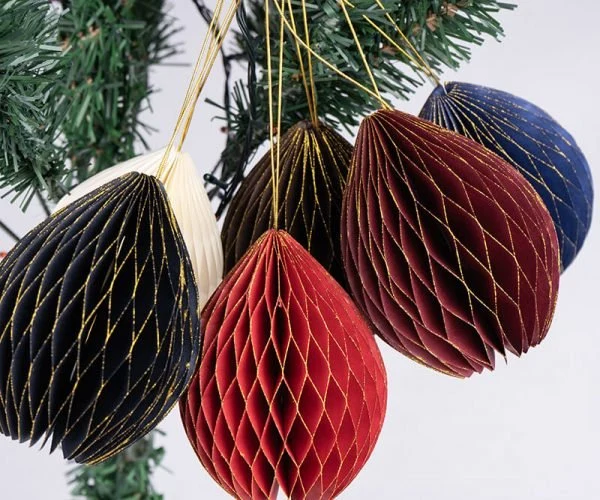
Start with a Seasonal Assortment, Not a Product Photo
A Christmas buyer can find attractive paper ornaments in minutes. The harder task is building a range that works as a retail collection: the pieces need to share a visual direction, fit the intended price points, arrive in sellable condition and be packed in a way that makes sense for the sales channel.
The first question should not be, “What is your price for this ornament?” It should be, “What role does this item play in the collection?” A hanging tree ornament, a tabletop paper tree and a large display decoration may share a seasonal theme, but they do not have the same dimensions, construction, packaging or merchandising purpose.
For a reliable wholesale order, define the product family, quantity per design, finished size, construction, color direction and retail pack before comparing supplier prices. This gives every supplier the same brief and makes quotation differences easier to understand.
For a first planning pass, divide the range into three groups:
| Product role | Typical buyer objective | Details to define |
|---|---|---|
| Hanging ornaments | Fill a tree-decoration assortment or gift range | Opened size, hanging loop, weight, color and individual protection |
| Tabletop paper trees | Add shelf, mantel or counter display pieces | Height, base stability, folded or assembled condition and pack size |
| Coordinated seasonal accents | Build a wider Christmas presentation | Color family, motif, number of designs and set composition |
The exact products available depend on the selected range. Use the table as a planning framework, not as a claim that every construction or style is offered by every supplier.
A useful starting point is the LuckinDecor paper Christmas tree range. If the project also needs complementary hanging or party pieces, review honeycomb decorations and paper garlands as separate product families.
Choose the Construction Before You Finalize the Appearance
Two paper decorations can look similar in a catalogue image but behave very differently when opened, displayed, folded and packed. The construction determines how the product is assembled, how much space it occupies in the carton and what the buyer needs to explain to the end customer.
Common paper-decoration formats include:
- Folded or accordion structures: Paper sections open into a three-dimensional form. Confirm how the shape is secured and whether the item can be folded again for storage.
- Honeycomb structures: Cut and bonded paper layers open into a cellular form. Confirm the opened dimensions, closure method and whether the hanging component is supplied.
- Flat or layered paper shapes: Die-cut or layered pieces can be suitable for lightweight hanging or tabletop presentation. Check edge quality, attachment points and whether extra assembly is required.
Do not select a construction from a photograph alone. Ask for a close-up of the opened structure, a folded view and a short assembly demonstration where the design requires one.
Questions to ask about construction
- Is the product supplied flat, folded, partly assembled or ready to display?
- What holds the decoration open: adhesive tabs, clips, magnets, ties or another method?
- Is the hanging cord or attachment included in the quoted product?
- Can the product be closed again after use, and are instructions supplied?
- Are there exposed glue lines, sharp edges or fragile decorative details that need protection in transit?
A supplier should answer these questions for the exact design. Do not assume that two ornaments in the same broad category use the same paper, joining method or closure system.
Create a Specification Sheet for Every SKU
A seasonal order often contains many designs, colors and sizes. If the specification is recorded only in email messages or annotated photographs, small differences can be missed when samples and production are reviewed.
Create one line per SKU. At minimum, include the following information:
| Specification field | What the buyer should provide or confirm |
|---|---|
| Product reference | Supplier reference, drawing or approved image |
| Opened dimensions | Height, width and depth after the decoration is assembled |
| Folded dimensions | Packed or closed dimensions, where applicable |
| Material | Paper type, stated paper weight or grade, and any non-paper components |
| Color | Physical color reference, Pantone reference where appropriate, or an approved sample |
| Finish | Printed, plain, coated, metallic detail or another confirmed finish |
| Hanging or support | Cord type, attachment point, base or support component |
| Assembly | Required steps, tools if any, and instruction-card requirement |
| Retail pack | Single item, multi-piece set, back card, bag, box or other format |
Paper weight alone is not a complete material specification. A quoted GSM value does not tell you the full construction, surface finish, adhesive, reinforcement or performance of a finished ornament. Request a model-specific description and inspect a representative sample.
For a custom range, also provide artwork in a usable format and identify which elements must remain consistent across the collection. If colors are important to the brand, approve a physical sample rather than relying only on a screen image.
Approve the Sample Against Written Acceptance Points
A sample should be more than a visual preview. It is the point at which the buyer checks whether the product brief has been translated into a repeatable item.
Before approving a paper Christmas decoration, review it against a short acceptance list:
- Shape and proportion: Does the opened product match the approved drawing and intended display size?
- Color and print: Are the main color areas, print alignment and visible finish consistent with the approved reference?
- Opening and closure: Does the product open correctly? Does the closure hold the intended shape without damaging the paper?
- Hanging or support: Is the attachment positioned correctly, and does it hold the sample in its intended display orientation?
- Edges and finish: Are cuts clean? Are glue marks, crushed areas or visible defects within the agreed acceptance standard?
- Assembly and instructions: Can the buyer or retail customer understand how to display the item?
- Pack-out: Does the sample fit the proposed retail packaging without unnecessary compression or damage?
If a sample is revised, record what changed and approve the final version. Keep the approved sample or a clear photo record as the reference for the purchase order. A vague approval such as “looks good” leaves too much room for different interpretations.
For multi-SKU projects, approve the representative construction and the important color combinations. Do not assume that approval of one size or one color automatically approves every variation.
Plan Retail Packaging and Export Cartons Together
Retail packaging and export packaging solve different problems. Retail packaging presents the product to the buyer’s customer. Export packaging protects the product during handling and transport. A good wholesale brief considers both before the order is finalized.
For retail presentation, specify:
- Whether each ornament is sold individually or as a set.
- Whether the product needs a backing card, clear bag, window box, gift box or insert.
- The number of pieces in each retail unit and the exact color or design mix.
- Brand artwork, barcode, language, product description and any required warnings.
- Whether assembly instructions or a hanging accessory must be included.
For export packing, ask the supplier to confirm the packed dimensions, net weight, gross weight, units per carton and total carton count. Request the total shipment volume in cubic metres (CBM) when freight planning requires it.
A product that looks compact in a photograph may need more space when protected by inserts or retail boxes. Conversely, a fold-flat design may be packed efficiently if its construction and retail presentation allow it. The correct comparison is not simply “small product versus large product”; it is the final packed unit and master carton.
You can also review LuckinDecor’s private-label packaging approach when a project requires branded retail packs or coordinated sets.
Plan MOQ, Sampling and Seasonal Timing by Design
There is no single MOQ or production lead time that applies to every paper Christmas decoration. The requirement can change with the construction, number of colors, printing, custom artwork, tooling, retail packaging and number of different SKUs in the order.
A buyer should ask the supplier to separate the timing into stages:
- Brief review: Confirm the product references, dimensions, materials, color direction and quantities per design.
- Artwork or digital proof: Review the shape, print layout, color references and packaging artwork where applicable.
- Physical sampling: Confirm which designs require a sample and whether the sample includes the final retail pack.
- Sample revision and approval: Record the final approved version before bulk production.
- Production and inspection: Agree the production window and the inspection points for the order.
- Packing and dispatch: Confirm carton data, shipment readiness and the agreed delivery arrangement.
Seasonal products should be planned backwards from the required arrival date, not from the date the buyer hopes to place the order. Allow time for artwork correction, sample delivery, approval, production, inspection and transport. A supplier’s estimated production time is not the same as the time required for the goods to reach the buyer’s warehouse.
Ask for MOQ and lead time by product family or SKU where the range contains different structures. A mixed order should not be assumed to have one uniform minimum or one production schedule.
Compare Supplier Quotations on the Same Basis
A low unit price is useful only when the quoted products are genuinely comparable. One supplier may quote a basic ornament without a hanging cord or retail pack, while another may quote a finished retail unit. Comparing those figures directly can lead to the wrong purchasing decision.
Use a comparison sheet with the following fields:
| Comparison point | What to check |
|---|---|
| Product specification | Same dimensions, material, construction and finish |
| Included components | Hanging cord, base, insert, instruction card and other accessories |
| Quantity basis | Quantity per design, color and retail set |
| Sample and setup | Sample charges, printing plates, tooling or other one-time costs |
| Retail packaging | Same pack type, label, barcode and set contents |
| Export packing | Units per carton, carton dimensions, gross weight and total CBM |
| Quality agreement | Approved sample and written acceptance points |
| Delivery terms | Same named delivery basis, destination and exclusions |
Ask the supplier to identify anything that is optional or excluded. Confirm the quotation validity and the assumptions behind any production or shipping estimate. This makes the comparison transparent and helps prevent a low headline price from hiding a different product specification.
Wholesale Paper Christmas Decoration Buyer Checklist
Before issuing a purchase order, check that the following points have been agreed in writing:
- [ ] The range is divided into individual SKUs with quantities per design and color.
- [ ] Opened and folded dimensions are specified where relevant.
- [ ] Material, finish, hanging parts and closure method are confirmed.
- [ ] Artwork and color references are approved.
- [ ] The final physical sample is approved and retained as the reference.
- [ ] Retail pack contents, labels and barcodes are confirmed.
- [ ] Carton dimensions, gross weight, carton quantity and total CBM are available.
- [ ] MOQ, sampling, production and dispatch timing are confirmed by the selected product mix.
- [ ] Optional components and excluded costs are clearly identified.
- [ ] The delivery destination and required arrival date are included in the order plan.
Frequently Asked Questions
Can I combine several paper Christmas ornament designs in one wholesale order?
A mixed-SKU order can be discussed, but the MOQ and production requirements may differ by design, construction, color and packaging. Provide the quantity for each SKU rather than only a combined total.
Should I approve a digital proof or a physical sample?
A digital proof is useful for reviewing artwork and layout. A physical sample is needed to check the actual paper, opening method, finish, dimensions and pack-out. The required approval stage depends on the project.
What information should I send when requesting a quotation?
Send product references, quantity per design, size, color, artwork, retail packaging, destination and target arrival date. If you have a sample or drawing, include it with the brief.
Can paper Christmas decorations be customized for a private-label range?
Customization depends on the product structure and production process. Share the artwork, color references, target pack format and quantity per design so the supplier can review feasibility before sampling.
A well-planned seasonal order starts with a clear assortment and ends with an approved product and packing specification. If you are developing a Christmas range, explore paper Christmas decorations or contact LuckinDecor with your product list, quantities and packaging brief.