Trying to source products for your party supply business can feel like navigating a maze, especially when it comes to wholesale piñatas. You ask for a supplier's minimums, but the answers are often confusing or incomplete, making it tough to plan your inventory and budget. The real problem is the risk of either overcommitting your cash on too much stock or failing to build the vibrant assortment your customers demand. Understanding the piñata wholesale MOQ isn't about finding a single magic number; it's about decoding a system that directly impacts your business's success.
A piñata wholesale MOQ is rarely a single number. It is a system of three distinct minimums: a minimum total order quantity or value (for the entire invoice), a minimum quantity per design (e.g., 300 unicorn piñatas), and often a minimum quantity per color variation within that design (e.g., 100 pink unicorns, 100 blue, and 100 purple). Understanding all three is essential for calculating your true inventory commitment and financial outlay.
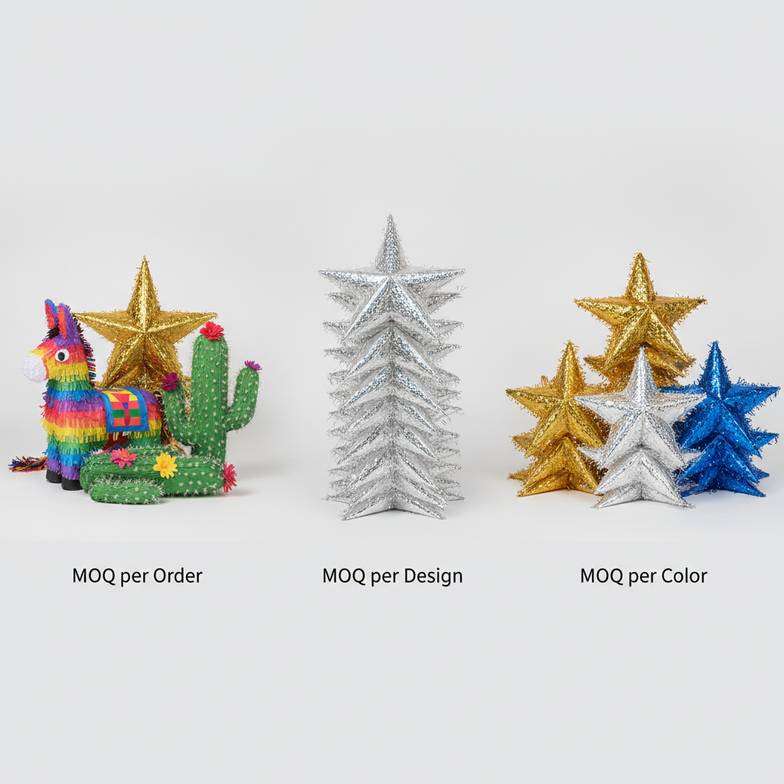
Now that you know it's a three-part system, you have a huge advantage. Let's break down what each of these minimums means, why suppliers have them, and how you can use this knowledge to choose the right sourcing partner for your business.
What's the Difference Between MOQ Per Order and MOQ Per Design?
You’ve found a supplier with an attractive, low total order MOQ, maybe $2,000. You get excited, thinking you can order a wide variety of piñata styles. But then you see the fine print: a 500-unit minimum per design. Suddenly, your plan to offer 10 different piñatas is completely upended.
The MOQ per order refers to the minimum for your entire purchase from the supplier, which can be a total dollar value or a total number of items. In contrast, the MOQ per design is the minimum number of units you must order for one specific model, like a donkey, a star, or a dinosaur.
Why Suppliers Have a 'Per Design' Minimum
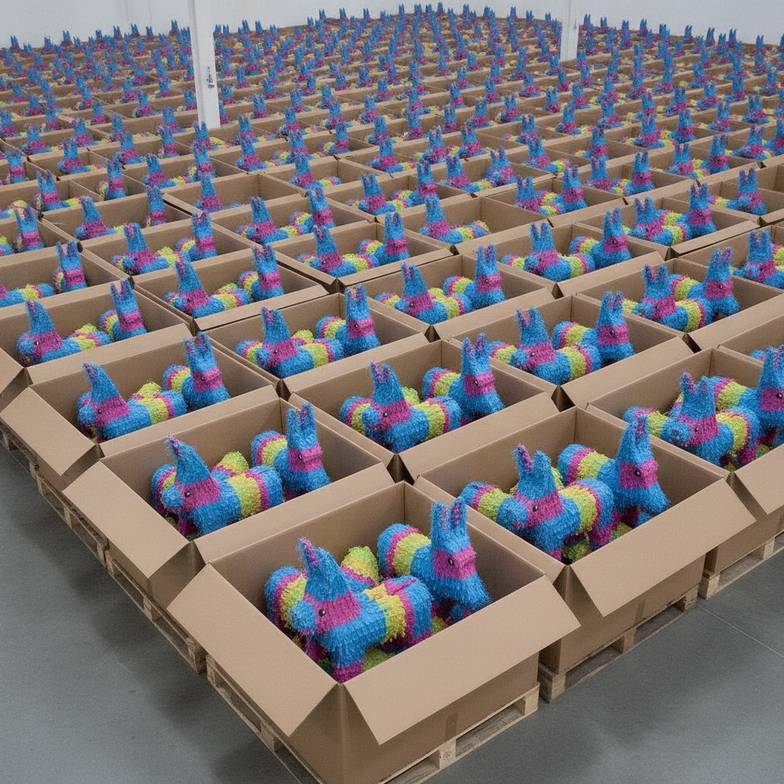
A common point of confusion we hear from new buyers is why they can't just order 50 of this and 50 of that. The 'per design' minimum isn't arbitrary; it's rooted in the economics of production. Every new design requires a setup process.
Think about it from the factory's perspective:
- Molds and Templates: Creating a unique piñata shape, like a specific cartoon character or animal, requires making new molds or cutting templates. This is a fixed, upfront cost in both time and materials.
- Labor Training & Efficiency: When workers start on a new design, the first few dozen units are always slower to produce. They have to learn the specific folding, gluing, and decorating techniques. The production line only becomes efficient once they get into a rhythm.
- Material Allocation: Specific materials, like printed cardboard or unique decorative elements for one design, must be sourced and allocated.
The MOQ per design ensures that the production run is large enough to absorb these initial setup costs and achieve a level of efficiency that makes the order profitable. Without it, the cost per piñata would be significantly higher.
How MOQ Per Design Impacts Your Business
The "right" MOQ per design depends entirely on your business model. There's no one-size-fits-all answer.
- For Wholesalers and Distributors: If you're supplying a large network of retailers, a high MOQ per design (e.g., 500-1,000 units) on a staple item like a classic birthday cake piñata might be perfectly acceptable. You have the channels to move that volume, and buying deep on one SKU simplifies your logistics.
- For Retailers and Online Sellers: This is where a high MOQ per design can be a real killer. Your strength is offering variety and catering to niche trends. Committing to 500 units of a single, untested design is a massive inventory risk. In my experience, boutique owners and online sellers thrive when they can test 10-20 different designs with smaller quantities. A high per-design minimum makes this strategy impossible. You need a supplier whose MOQ allows you to build a broad, not just deep, product assortment.
Why Does the Piñata Wholesale MOQ for Each Color Matter So Much?
So, you've navigated the first two hurdles. You found a supplier with a reasonable total order value and an acceptable MOQ per design—say, 240 units for a star-shaped piñata. You plan to order 60 units each of gold, silver, red, and blue. But then the supplier responds, "Our MOQ is 240 units per color." Your planned order of 240 units just ballooned to 960 units.
The piñata wholesale MOQ per color is the minimum quantity you must purchase for each color variation of a single design. It's the most frequently overlooked detail, and in my opinion, it's the most critical factor for buyers who depend on having a diverse product catalog. This minimum is tied directly to the realities of raw material sourcing.
The Production Logic Behind 'Per Color' Minimums
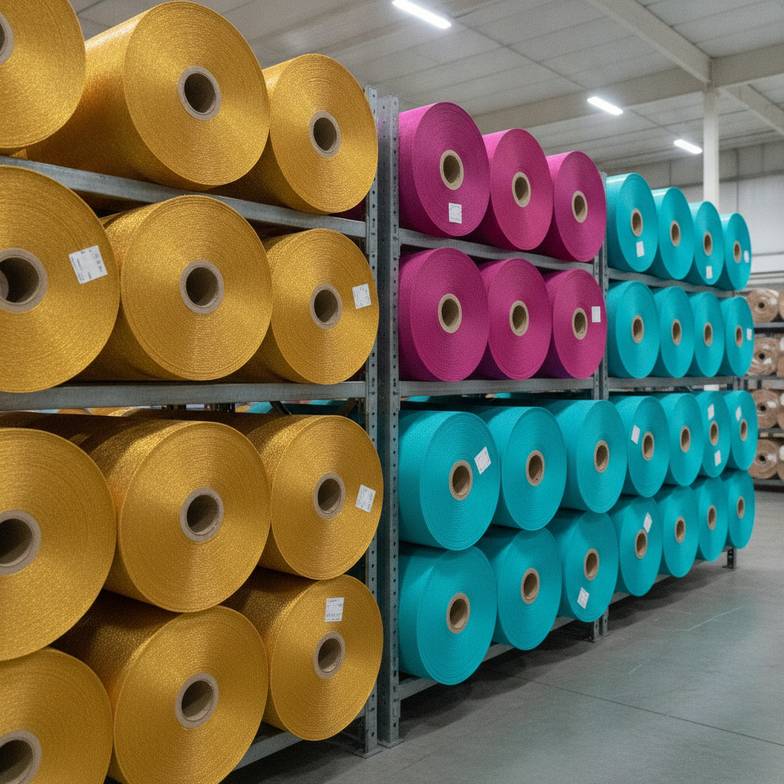
When a buyer asks me why they can't just get 50 of this color and 50 of that, I explain that it comes down to how we procure materials. The vibrant tissue paper that covers a piñata isn't something we can buy in small craft-store quantities.
Our material suppliers—the ones who make the paper itself—have their own MOQs. To get a specific Pantone shade of tissue paper, we often have to commit to buying a massive roll or a large batch of it. A factory simply can't order a tiny amount of fuchsia, a bit of teal, and a little bit of lime green. They have to buy in bulk for each color.
The MOQ per color allows the piñata manufacturer to:
- Meet the minimums of their own raw material suppliers.
- Manage their raw material inventory efficiently.
- Avoid having tons of leftover, unused rolls of an obscure color they can't use for other orders.
It's a cascading effect down the supply chain. Your supplier's MOQ is influenced by their supplier's MOQ.
Calculating Your True Commitment: The Most Important Step
This is where you need to get out your calculator. A low "per design" MOQ can be incredibly misleading if the "per color" MOQ is high. It's a classic trap that catches many first-time buyers.
Let's walk through a realistic scenario. You want to stock a popular "Donkey" piñata and offer it in 4 traditional colors.
| Supplier's Stated Terms | Your Plan | Reality Check |
|---|---|---|
| MOQ per Design: 300 units | You want 300 donkeys total. | Seems doable. |
| MOQ per Color: 200 units | You want 75 of each of 4 colors. | Plan Fails. |
| The Real Commitment: | To get 4 colors, you must order:<br>- 200 units (Color 1)<br>- 200 units (Color 2)<br>- 200 units (Color 3)<br>- 200 units (Color 4)<br>Total: 800 units for one design. |
As you can see, your actual minimum commitment for this single donkey piñata design is 800 units, not the 300 units you initially thought. This calculation is crucial for accurately forecasting your cash flow and inventory risk. Before you get excited about any supplier's numbers, always ask for all three parts of the piñata wholesale MOQ and run this calculation for a multi-color product.
How Can You Use Piñata Wholesale MOQ to Evaluate a Supplier?
It's easy to fall into the trap of just searching for the supplier with the lowest numbers. But a low MOQ isn't always a good thing, and a high MOQ isn't always bad. The key is to look at a supplier's MOQ structure as a reflection of their business model and see if it aligns with yours.
The MOQ is a powerful signal. Analyzing the balance between the order, design, and color minimums tells you about a supplier's scale, flexibility, and ideal customer. This helps you move beyond price and find a true partner.
What a High MOQ Profile Suggests
If you encounter a supplier with a high total order MOQ (e.g., >$10,000), a high MOQ per design (>1,000 units), and a high MOQ per color (>500 units), you're likely dealing with a massive-scale factory.
- Their Strengths: They are optimized for extreme efficiency and low-cost mass production. They are probably the direct suppliers for major international retail chains that need tens of thousands of a single piñata SKU for their holiday programs. Their consistency at scale can be very reliable.
- Their Weaknesses: They will have almost zero flexibility. Forget about small test orders, a wide assortment of designs, or custom tweaks. Their business model is built on volume, and if your order doesn't fit their high-volume production slots, they simply aren't a good match.
What a Low MOQ Profile Suggests
On the other end of the spectrum, you might find a supplier with very low minimums across the board—a low total order value and the flexibility to order just a few dozen units per design or color.
- Their Strengths: This signals flexibility. They might be a smaller workshop or a trading company with relationships across many small factories. This is excellent for new businesses, online sellers, or anyone wanting to test a wide variety of designs with minimal risk.
- Their Weaknesses: You must perform extra due diligence here. With low MOQs, you need to ask: Can they maintain consistent quality across different batches? What happens if one of your test designs becomes a huge hit? Can they scale production from 50 units to 5,000 units to meet your demand? I've seen buyers get into trouble when their "flexible" supplier couldn't keep up with their growth.
The 'Balanced' MOQ Profile: The Strategic Partner
The sweet spot for many businesses—especially independent retailers, growing online stores, and regional distributors—is a supplier with a balanced profile.
- Moderate Total Order MOQ: This shows they are a serious, professional B2B operation and not just a direct-to-consumer seller.
- Flexible Per-Design & Per-Color MOQs: This is the key. They understand that their customers need a healthy product assortment. They have structured their production to allow for variety. For example, they might have a 300-unit MOQ per design but allow it to be split across 3 colors (100 units each).
This type of supplier is looking for a long-term partnership. They understand that by helping you manage your risk and build a successful product line, they will grow alongside you. Their unit price might be slightly higher than the mass-production factory, but the value you gain in reduced inventory risk and increased flexibility is often well worth the trade-off.
Frequently Asked Questions
Can I negotiate the piñata wholesale MOQ?
Sometimes, but it depends on what you're trying to negotiate. The 'per design' MOQ can sometimes be flexible, especially if you are placing a large total order with many different designs. However, the 'per color' MOQ is often less negotiable because it's tied to the supplier's own raw material purchasing constraints.
Does custom design affect the MOQ?
Yes, almost always. A custom piñata design requires creating new molds, sourcing unique materials, and dedicated setup time. Because of these upfront, one-time costs, the piñata wholesale MOQ for a fully custom design will almost certainly be higher than for one of the supplier's standard, in-stock designs.
What is a typical piñata wholesale MOQ from China?
There is no "typical" number. It can range from as low as 100-200 units per design at a flexible supplier to over 2,000 units at a large-scale factory. The most important thing is to stop looking for a single number and start asking for the full structure: the minimum per order, per design, and per color.
Why is the MOQ for a small piñata the same as a large one?
This is a great question. It's because the primary cost drivers behind an MOQ are setup and material batching, not the amount of material in the final product. The labor to create a new mold and the cost of buying a minimum batch of a specific color of tissue paper are the same whether you're making a mini piñata or a jumbo one.
Conclusion
The next time you approach a supplier, you'll be armed with the right questions. Instead of just asking, "What's your MOQ?", you can confidently ask for their minimums per order, per design, and per color. Understanding the complete piñata wholesale MOQ structure is the key to moving from confusion to clarity. It allows you to accurately calculate your financial commitment, manage your inventory risk, and, most importantly, choose a supply partner whose production model truly aligns with your business goals. This knowledge protects your cash flow and empowers you to build the diverse, exciting product assortment your customers will love.
If you are looking for a sourcing partner who understands the crucial balance between production realities and the need for assortment flexibility, we should talk. Let's discuss your specific needs and work together to build a successful piñata program that works for your business.