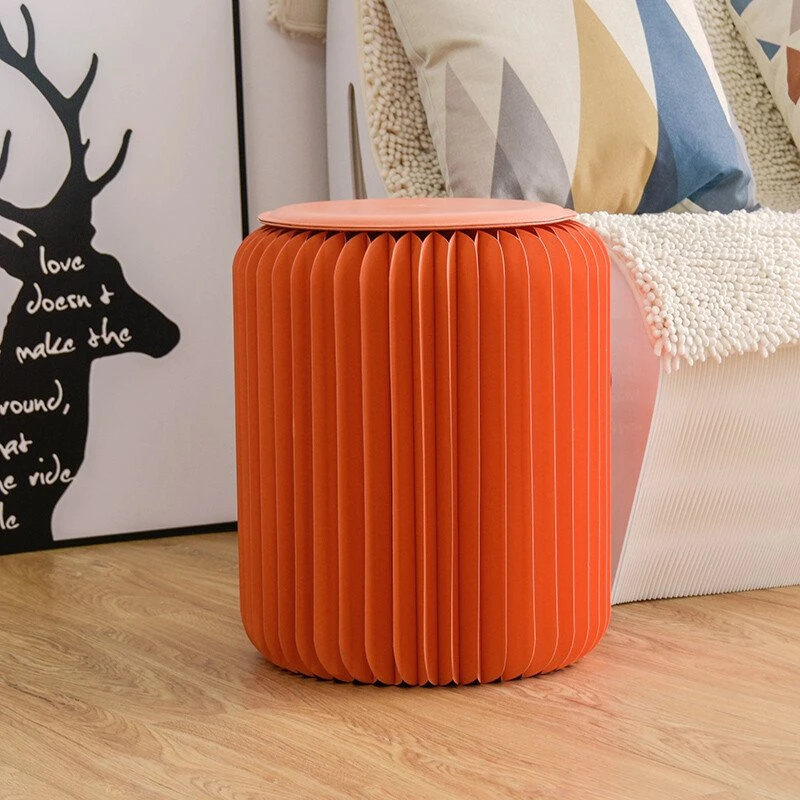
Paper Furniture Is a Construction, Not a Single Material
The phrase “paper furniture” can describe several different products: an expandable stool, a foldable display, a lightweight room divider or a paper-based presentation unit. They may all use paper, but they do not necessarily share the same structure or performance requirements.
A buyer who asks only “Is it made of paper?” has not yet defined the product well enough to compare suppliers. The important questions are what paper is used, how the layers are arranged, what holds the structure together and what the product is intended to do.
Paper furniture is generally a paper-based assembly whose suitability depends on the exact paper structure, facing layers, joints, surface finish and intended use—not on the word “paper” alone. A common expandable format uses a cellular or honeycomb-like paper structure, but the construction of each model must be confirmed from its own specification.
For LuckinDecor’s Paper Displays & Furniture range, buyers should distinguish a decorative display from a product designed for seating. A similar shape or a strong-looking paper core does not establish that two products have the same intended use.
Understand the Main Components of a Paper-Based Structure
A paper furniture product may contain several components. Not every design uses all of them, and the material of one component should not be assumed to describe the whole product.
| Component | Possible role | What the buyer should verify |
|---|---|---|
| Paper core or folded structure | Creates the internal shape and structural depth | Core design, paper grade, cell or fold geometry and orientation |
| Outer facing or surface paper | Covers the structure and provides the visible finish | Paper type, weight, color, print and surface treatment |
| Top and bottom panels | Provide contact surfaces or help retain the opened form | Panel material, thickness, edge treatment and attachment |
| Adhesive and joints | Bond paper layers or connect components | Joining method, consistency and any model-specific limitations |
| Fasteners or closure parts | Help the product open, close or remain assembled | Exact type, location, replacement availability and instructions |
| Cushion or cover | Adds a separate contact surface on seating designs | Material, attachment, cleaning instructions and whether it is included |
This component view is more useful than a broad statement such as “made from kraft paper.” A paper-based product can contain additional panels, fabric, plastic, metal or other parts. The quotation should identify those components where they affect use, packaging, environmental claims or end-of-life handling.
How an Expandable Honeycomb Paper Structure Works
One common format in foldable paper furniture uses a cellular paper core. When opened, the connected cells expand into a three-dimensional structure. When closed, the structure can be compressed into a flatter form for storage or transport.
The honeycomb appearance is only the visible geometry. The performance of the finished product depends on more than the shape of the cells. Paper grade, cell dimensions, bonding quality, orientation, panel support, edge closure and the way the product is assembled can all affect the result.
For a buyer, the practical questions are:
- Does the product open to a repeatable shape?
- Are the cells evenly formed and consistently bonded?
- Are the top and bottom edges supported or finished?
- What prevents the product from closing or shifting during normal use?
- Does the supplier provide a clear opening and closing instruction?
- Is the product designed for display, occasional seating or another specific purpose?
Do not infer a load rating from a honeycomb pattern. Two products can look similar while using different paper, dimensions, bonding and support details. Any load or stability claim must relate to the exact finished model and its documented test configuration.
Paper Grade, Thickness and GSM Are Not the Whole Specification
Suppliers may describe paper by type, basis weight or GSM (grams per square metre). These details are useful, but they do not independently establish the strength or durability of a finished furniture product.
A complete material review should consider:
- Paper type and grade: Ask whether the paper is kraft, another paper grade or a combination of materials.
- Basis weight: Confirm the stated GSM and which component it describes. A GSM value for the outer facing does not automatically describe the core.
- Thickness and layer count: Ask how the finished panel or structure is built.
- Cell or fold geometry: For an expandable design, request a drawing or close-up showing the structure.
- Bonding and edge support: Ask how the paper layers are joined and how exposed edges are finished.
- Surface treatment: Confirm whether the product has a coating, print, laminate or other finish.
A supplier should be able to explain which material details apply to the exact product being quoted. If a specification sheet lists only “paper” or “kraft cardboard,” ask for the missing construction information before using the description in a technical comparison.
Check the Surface Finish, Adhesive and Additional Components
The visible surface affects more than appearance. It can influence how the product is cleaned, how it responds to abrasion and whether the product can be recycled or disposed of with other paper materials. A coating or laminated layer may change the material composition of the finished item.
For each non-paper component, ask whether it is essential to the construction or an optional accessory. This is particularly important for a paper stool or other product intended for contact with people.
Confirm the following:
- Whether the surface is uncoated, printed, coated or laminated.
- Whether the color is part of the paper, printed onto it or supplied as a separate covering.
- Whether the product includes a cushion, cover, plastic fitting or metal fastener.
- Whether the joining method is adhesive, mechanical or a combination.
- Whether any component needs special care, replacement or separate disposal.
Avoid making a broad “100% paper” claim unless the complete product—including its closures, adhesives, labels and packaging—has been checked against that statement.
What to Request from a Supplier Before Comparing Paper Furniture
A product photo is a useful reference, but a buyer needs a specification that can be checked and approved. Ask for the following information for the exact model:
| Information | Why it matters |
|---|---|
| Product type and intended use | Distinguishes a display unit from seating or another functional product |
| Opened and folded dimensions | Helps evaluate fit, display and storage |
| Material breakdown | Identifies paper and non-paper components |
| Construction drawing or close-up | Shows the core, panels, joints and closure |
| Net weight | Helps plan handling and packing |
| Assembly instructions | Defines how the product should be opened and secured |
| Surface care instructions | Clarifies cleaning and storage limits |
| Model-specific test evidence | Supports any load, stability or performance claim |
| Retail and export packing | Defines protection, carton size and shipping data |
If the supplier cannot provide a formal drawing, request clear photographs of the opened structure, the top and bottom panels, the joining points and the folded condition. Keep the information with the approved sample and quotation.
Inspect a Sample Instead of Relying on the Material Name
A representative sample helps the buyer evaluate the finished construction. Inspect the product in both its open and closed condition. Look for uneven cells, loose bonds, damaged edges, inconsistent dimensions and any parts that do not align as shown in the instructions.
For a product intended as a stool, the sample review must also follow the product’s intended-use instructions. Check the specified assembly, closure and support components. Do not sit on a display product or test a product beyond the supplier’s stated use and documented limits.
Record the sample findings in writing:
- Product reference and revision.
- Opened and folded dimensions.
- Confirmed material components.
- Surface finish and color.
- Assembly and closure method.
- Included accessories and packaging.
- Any test documents or use limitations.
This record helps prevent a later production sample from being compared against a different model or an incomplete photograph.
Paper Furniture Materials: Final Buyer Checklist and FAQs
Before approving a paper furniture order, confirm the exact product and its construction:
- [ ] The intended use is stated: display, seating or another application.
- [ ] The paper core, facing layers and any panels are identified.
- [ ] GSM or paper grade is tied to the correct component.
- [ ] Adhesives, fasteners, cushions and other non-paper parts are listed.
- [ ] Opened and folded dimensions are confirmed.
- [ ] Assembly, care and storage instructions are available.
- [ ] Any performance claims have model-specific evidence.
- [ ] The sample and retail/export packaging are approved.
Frequently Asked Questions
Is all paper furniture made with honeycomb paper?
No. Honeycomb is one common expandable structure, but paper furniture and paper display products can use different folded, layered or panel-based constructions. Ask for the exact model’s material breakdown.
Does a higher GSM always mean stronger paper furniture?
No. GSM describes basis weight, not the performance of the complete product. Core geometry, bonding, panel support, orientation and assembly also matter.
Can paper furniture include plastic, metal or fabric?
Yes, some designs may include non-paper components such as fasteners, panels, covers or cushions. Ask the supplier to list what is included in the finished product.
How can I confirm whether a paper stool is suitable for seating?
Request the intended-use instructions and model-specific load and stability evidence. A paper display stand should not be treated as a seat just because it has a stool-like shape.
What should be included in a wholesale paper furniture quotation?
Ask for the model reference, material breakdown, dimensions, intended use, assembly instructions, approved sample, included components and packing data.
Understanding the construction is the first step toward a reliable specification. Explore the LuckinDecor paper furniture range or discuss a custom design with the intended use, dimensions and order quantity.